
Baryton
after Stadlmann, Vienna, 1732 + 1750

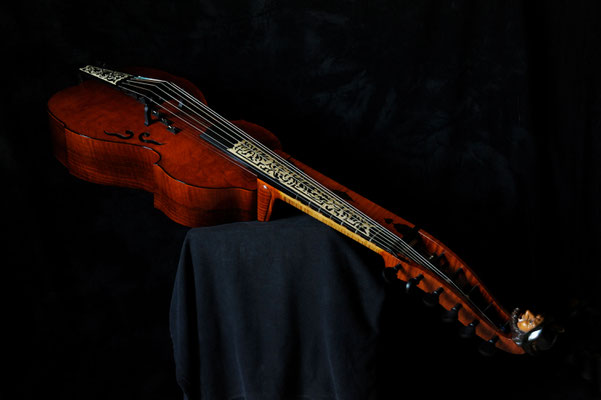
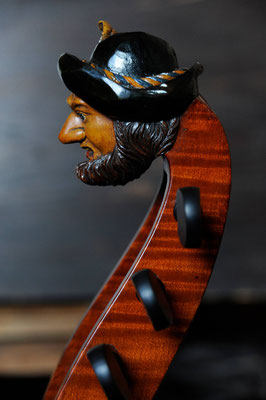
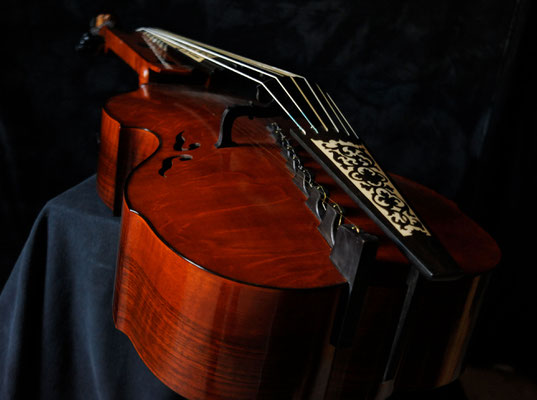
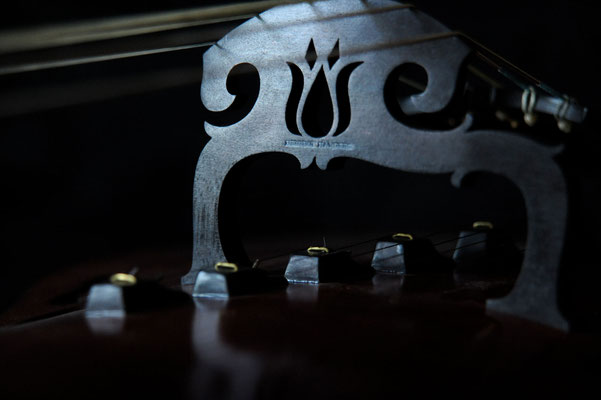
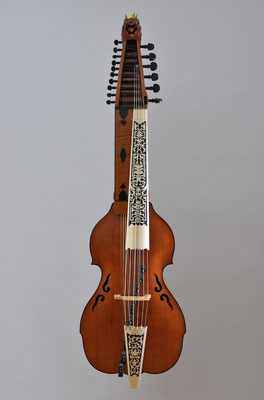


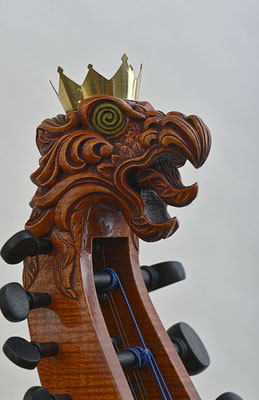


after Stadlmann, Vienna, 1732 + 1750
For my first baryton I used the instrument of Johann Joseph Stadlmann, which he built for Prince Esterhazy in Vienna 1750. The original is located in Budapest and is very highly decorated. For example, the back is made up of three parts with a wavy joint, and it has alternating ebony and ivory half edging in all possible locations!
7 bowed strings, 10 resonating strings, string length approx. 63.5 cm.
The instrument shown in the photos here is my interpretation of the Daniel Agnatius Stadlmann from 1732. The original instrument is in the KHM in Vienna. I have used flamed walnut for the ribs and back. The string length on this instrument is 65 cm.
'This is what the owner of my first baryton has to say about is instrument:
It is my great pleasure to play a baryton made by Henner Harders. This instrument speaks very light and brisk, has a noble sound and a good characteristic resonance. Perfection and accuracy of carvings - 'real viol maker's masterpiece' - this is not only my opinion, but also that of many musicians in Poland'.
Kazimierz Gruszczyñski - founder and leader of The Polish Baryton Trio
As a player, I have been particularly impressed by the instrument’s responsiveness and resonance. It has a distinctive sound that is beautifully silvery, complex and yet clear, particularly in the register supported by the sympathetic strings, and having given numerous concerts in many different venues, I have found that it projects remarkably well, even in larger spaces. Despite the potential complexity of the baryton as an instrument, the set-up allows this baryton to be played with ease, with the left hand able to reach all wire strings comfortably (even without a large hand), alongside all the other hallmarks of an excellent set-up one would expect from such a skilled luthier, and I have found the tuning to be very stable.
Above all, it has been a genuine joy to play, and its sound and work-of-art appearance have been widely admired by audiences and colleagues
alike.
Laura Vaughan, viol player from Melbourne, Australia, www.gryphonbaryton.com
Photos 1-5 by R. Scheikowski


Violworks - Henner Harders, Susanne Küster
Mansfelder Strasse 48 | D-16949 Putlitz / Mansfeld
phone/fax: +49 (0)33981 505434 | e-mail: info(at)violworks.com